
Rewiring
Old wiring you cannot see is still doing a hard job
Wiring in an older house was installed for far less load than it carries today, and some older cable types deteriorate with age. A rewire replaces it with modern cable, a new switchboard and RCD protection, and is the chance to put power and lighting where you actually need them. Plexus tests first, so you know whether a full rewire is needed or whether a partial one will do.
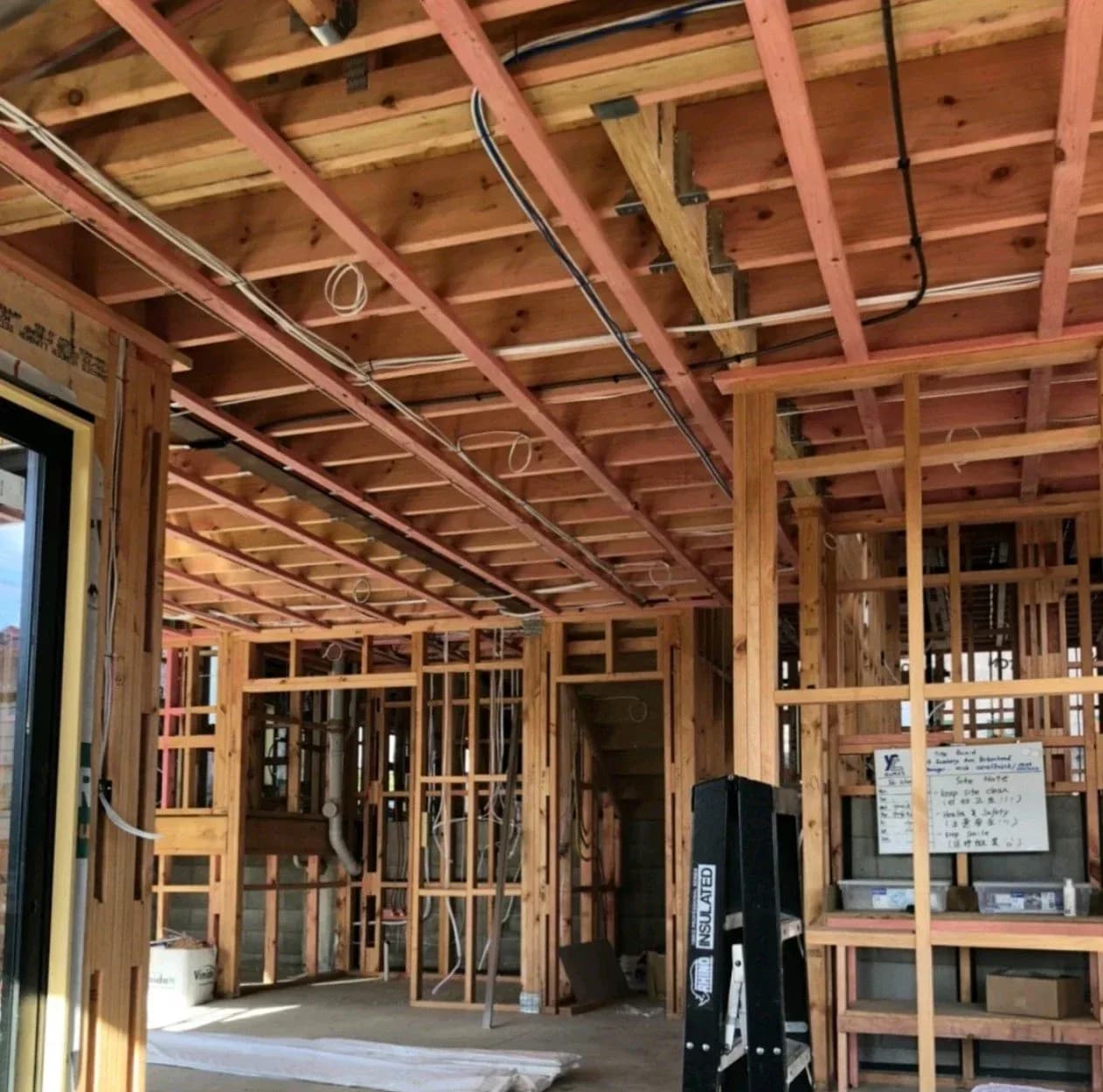
With linings off, new cable can be run cleanly through the frame.
Full and partial rewires for older Auckland homes, planned to limit disruption and to leave the house ready for modern loads.
Have your wiring checkedSigns it may be time to rewire
None of these proves the house needs a full rewire, but each is a reason to have the wiring tested.
- The house is old and has never been rewired, or you do not know when it was.
- Rubber-insulated or cloth-covered cable visible in the ceiling or under the floor.
- Power points with no earth pin connection, or two-pin outlets.
- Old round or ceramic switches and fittings, or fittings that are cracked or brittle.
- A switchboard with rewireable fuses and no RCD protection.
- Frequent tripping, flickering lights or warm switches and outlets.
- Wiring added over the years by different people, without records.
- You are about to renovate, add an EV charger, an induction cooktop or heat pumps, and want the installation to handle it.
Older wiring we commonly find
Older homes in Auckland can contain several generations of wiring. These are the types we look for when we test.
- Rubber-insulated cable
- Older cable with rubber insulation (often called TRS or VIR by electricians). Rubber can harden and crack with age and heat, especially in hot ceiling spaces, so we test it and inspect it where it is accessible.
- Early plastic-sheathed cable
- Older TPS cable is often still serviceable. Testing tells us whether it can stay.
- Circuits without an earth
- Some older lighting circuits were installed without an earth conductor, which limits what fittings can be safely connected to them.
- Mixed and modified circuits
- Joins in the ceiling, extensions spliced onto old circuits and DIY additions are common in houses that have been altered several times.
Rewiring a villa
How new cable gets in without opening every wall
In most villas the new lighting circuits run through the ceiling space and drop inside the walls to the switches, and the power circuits run under the floor and come up inside the walls to the power points. That keeps holes in the walls to a minimum.
Old wiring is disconnected and removed where it can be reached, and the old fuse board is replaced with a new switchboard with RCD protection. Every house is different, so the routes are planned once we have looked in the ceiling and under the floor.
Full or partial rewire?
| Partial rewire | Full rewire | |
|---|---|---|
| When it suits | Testing shows most wiring is sound, with problem circuits or areas | Wiring is old throughout, or the house is being substantially renovated |
| What is replaced | Selected circuits, often with a switchboard upgrade | All circuits, outlets, switches and usually the switchboard |
| Disruption | Limited to the affected areas | Greater, unless done alongside a renovation |
| Good time to do it | Any time, or when renovating one area | When linings are off, or before moving in |
How a rewire is done
- STEP 01
Test and inspect
Insulation resistance and earth continuity testing on each circuit, plus inspection of accessible cable, to see what condition the wiring is in.
- STEP 02
Plan the layout
We agree new positions for power points, lighting and switches, and add the circuits a modern home needs (kitchen appliances, an EV charger, heat pumps).
- STEP 03
Plan access
In a lived-in house we use ceiling and underfloor space wherever we can, to minimise holes in walls. Where linings are coming off for a renovation, access is simpler.
- STEP 04
Rewire in stages
We work area by area so you have power for as much of the job as possible, and keep you informed about any shutdowns.
- STEP 05
New switchboard
Usually replaced at the same time, with RCD protection across the circuits. See switchboard upgrades.
- STEP 06
Test and certify
Every circuit is tested before livening, and you receive a Certificate of Compliance and an Electrical Safety Certificate.
Rewire once, ready for an EV, induction cooking and heating
If you are planning an EV charger, an induction cooktop or heat pumps in the next few years, tell us now. Running those circuits during the rewire costs far less than adding them afterwards, and the new switchboard can be sized for them. We install heat pumps and ducted systems too, so we can plan the heating and the wiring at the same time. See heat pump installation and EV charger installation.
For more on how to judge whether your house needs a rewire, read when to rewire a house.
FAQ
Rewiring: common questions
How do I know if my house needs rewiring?
Age alone is not enough to tell. The wiring needs to be tested and inspected. Signs worth acting on include rubber-insulated cable, no RCD protection, outlets without earths, and frequent tripping or warm fittings.
Can I live in the house during a rewire?
Usually, yes. We work in stages and use ceiling and underfloor access where possible, so most of the house stays usable. There will be some power shutdowns, which we plan with you.
Will there be holes in my walls?
Some, depending on construction and access. Ceiling and underfloor space reduce the number. Small openings may need patching and painting afterwards, which we will discuss before starting. A rewire during a renovation avoids this almost entirely.
Do I need a new switchboard when I rewire?
Usually, yes. An old board typically has no RCD protection and may not have space for the circuits a modern home needs.
How much does a rewire cost?
It depends on the size of the house, access to ceilings and floors, how many circuits and fittings are involved, and whether the switchboard is replaced. We price after testing and a site visit. Our article on when to rewire a house covers what drives the cost.
Is a partial rewire worth doing?
Yes, when testing shows most of the wiring is sound. Replacing the problem circuits and upgrading the switchboard can be a sensible step, with the rest done later, for example during a renovation.
What customers say
5.0 from 47 Google reviewsCustomer reviews
“Super professional guys, did a number of jobs for us, from a single power point installation to rewiring entire room and installing new lights. Ryan is down to earth and straight to the point man, absolute pleasure to deal with. Heavily recommended.”
“Ryan and his team are wonderful company to deal with, very professional, prompt, polite and friendly. They worked with us on what we wanted, and delivered, working around any issues that were found with our existing wiring. Overall, very happy.”
“We’ve been working with Ryan and his team at Plexus Electrical since 2016, and we can’t recommend him highly enough. Over the years, Ryan has consistently delivered exceptional service for our projects. He’s reliable, professional, and always brings a high level of expertise to every job. Whether it’s been smaller jobs or more complex work, he approaches everything with care and precision. It’s amazing having someone like Ryan as part of our trusted team. A true professional and a pleasure to work with!”
Have your wiring checked
Tell us roughly how old the house is, what you have noticed and whether a renovation is planned.
More on rewiring
Keep exploring
Services and tools