
EV charging
Charge at home overnight, without overloading the house
A wall-mounted charger is faster and safer for everyday charging than a portable cable in a power point, and a smart charger can schedule charging for cheaper off-peak power. Plexus installs home and workplace EV chargers across Auckland, and checks the switchboard and your total load first (cooking, hot water, heating and anything else that runs at the same time), so the charger and the rest of the house work together.
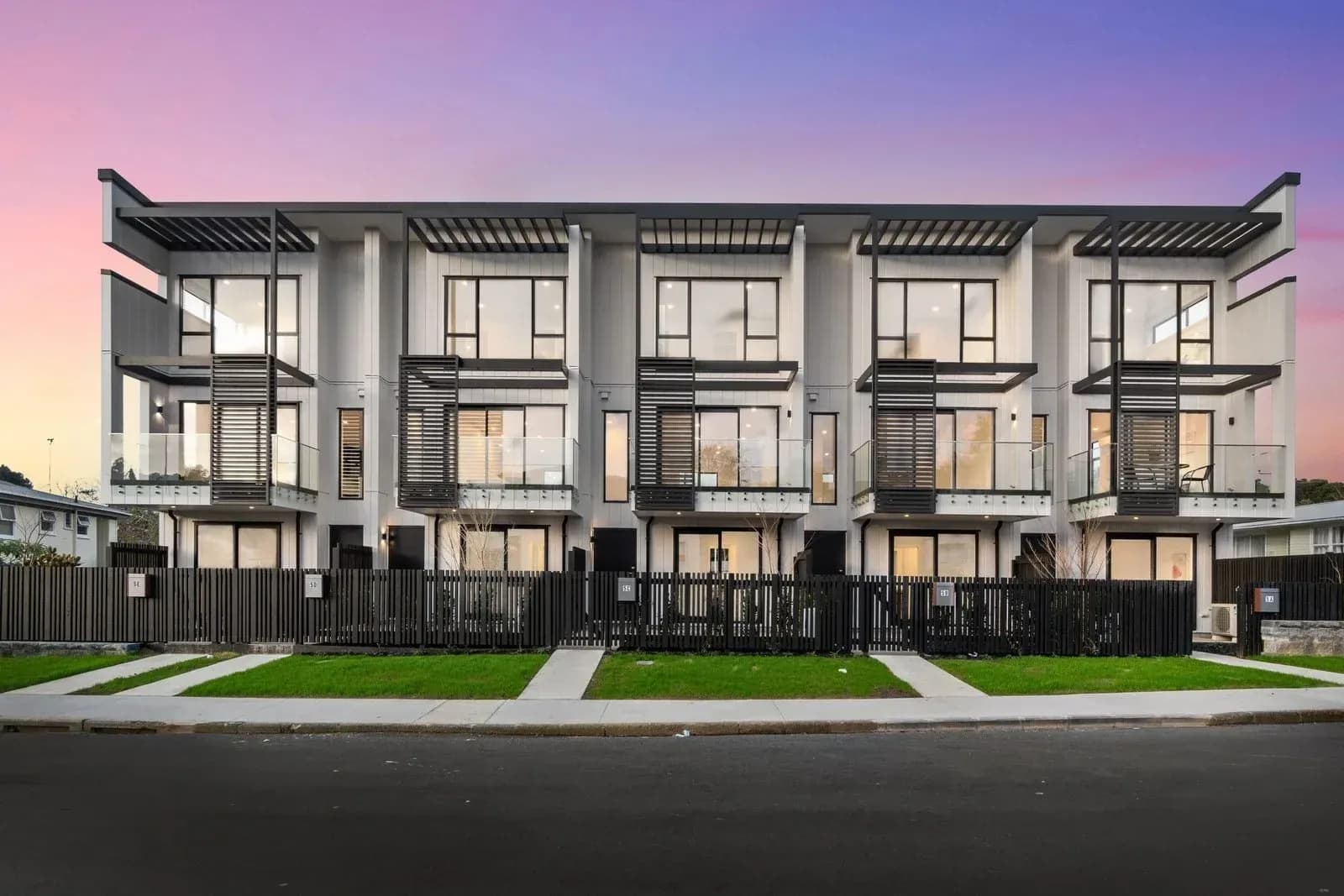
Home and workplace EV charger installation in Auckland, with the switchboard, load and cable route checked before anything is fitted.
Get an EV charger quoteWhy a wall charger rather than the cable that came with the car
Most EVs come with a portable charging cable that plugs into a standard 3-pin socket. It works, but EECA advises that 3-pin charging is for when other options are not available and is not recommended long term. EECA also says smart wall chargers are at least 3x faster than a 3-pin plug and much safer to use (EECA smart EV chargers).
A dedicated charger also runs on its own circuit, sized and protected for a load that will run for hours every night, rather than relying on a general power point shared with other appliances.
What a smart charger adds
Based on EECA's guidance on smart EV chargers.
Off-peak scheduling
Set charging to start when power is cheaper. EECA says this can save more than 20% of charging costs, though off-peak times and rates depend on your electricity plan.
Load balancing
A smart charger can power down automatically when the household is using a lot of power at once, reducing the risk of overload.
Remote control
Start, stop and monitor charging from an app, and see how much energy the car has used.
How it is installed
From the switchboard to the garage wall
We check the switchboard and the load on your supply first, then run a dedicated, RCD-protected circuit to where you park, mount the charger, and test and certify it.
A smart charger can be scheduled for cheaper overnight power and can turn itself down while the oven or other big loads are running, so the supply is never overloaded.
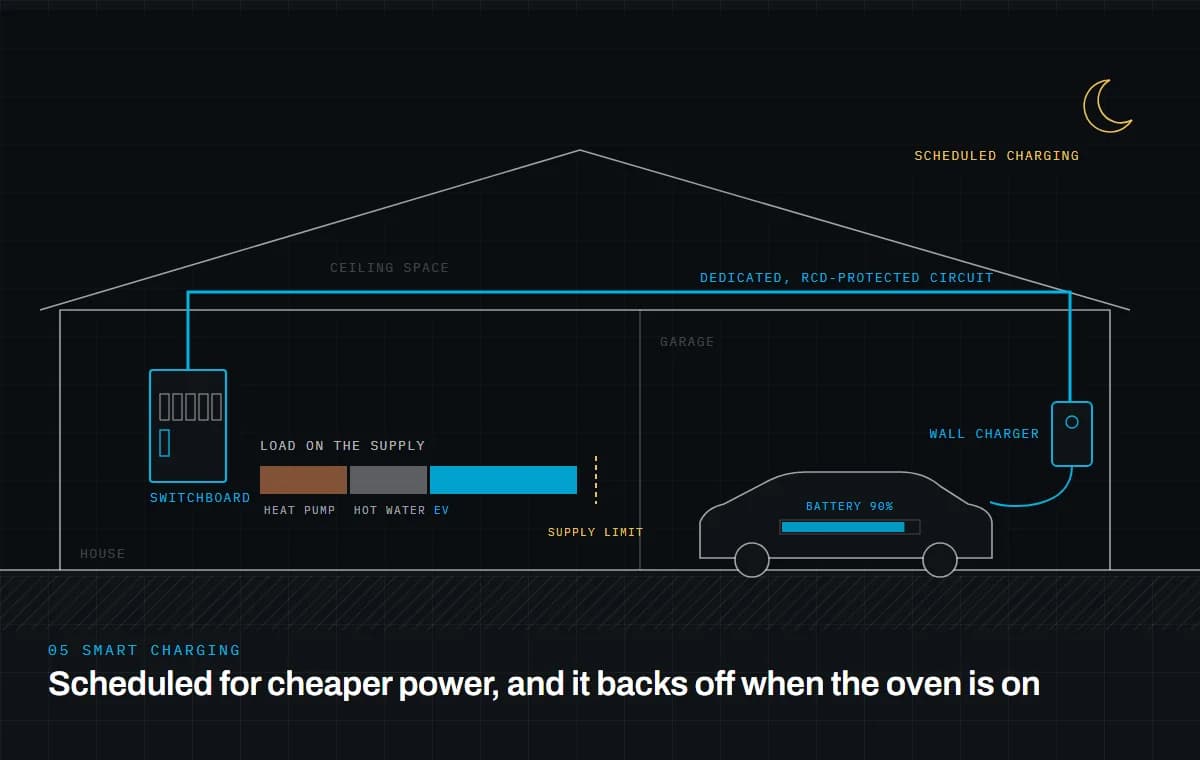
The switchboard is checked for space and protection. A bar shows the household load on the supply: heat pump, hot water and the EV, under the supply limit. A dedicated, RCD-protected circuit is run from the switchboard up through the ceiling space to the garage, and a wall charger is mounted and connected. At night the car charges on a schedule; when the oven comes on, the charger turns down so the total stays under the limit, then carries on.
Describe this animation
The switchboard is checked for space and protection. A bar shows the household load on the supply: heat pump, hot water and the EV, under the supply limit. A dedicated, RCD-protected circuit is run from the switchboard up through the ceiling space to the garage, and a wall charger is mounted and connected. At night the car charges on a schedule; when the oven comes on, the charger turns down so the total stays under the limit, then carries on.
How we install an EV charger
- STEP 01
Site check
We look at the switchboard, the supply to the house, where you park and the route the cable will take.
- STEP 02
Load assessment
We work out what else runs at the same time (oven, hot water, heating) and whether load management is needed.
- STEP 03
Charger choice
We talk through chargers that suit your car, your supply and whether you want smart features. EECA publishes a list of chargers it recommends.
- STEP 04
Installation
A dedicated circuit from the switchboard with the protection the charger requires, the cable run tidily, and the charger mounted where the cable reaches the car's charge port.
- STEP 05
Test and set up
The circuit and charger are tested, the app and schedule are set up with you, and we show you how it works.
- STEP 06
Certification
You receive a Certificate of Compliance and an Electrical Safety Certificate. EECA advises making sure you receive these from your installer.
Helpful to have when you ask for a quote
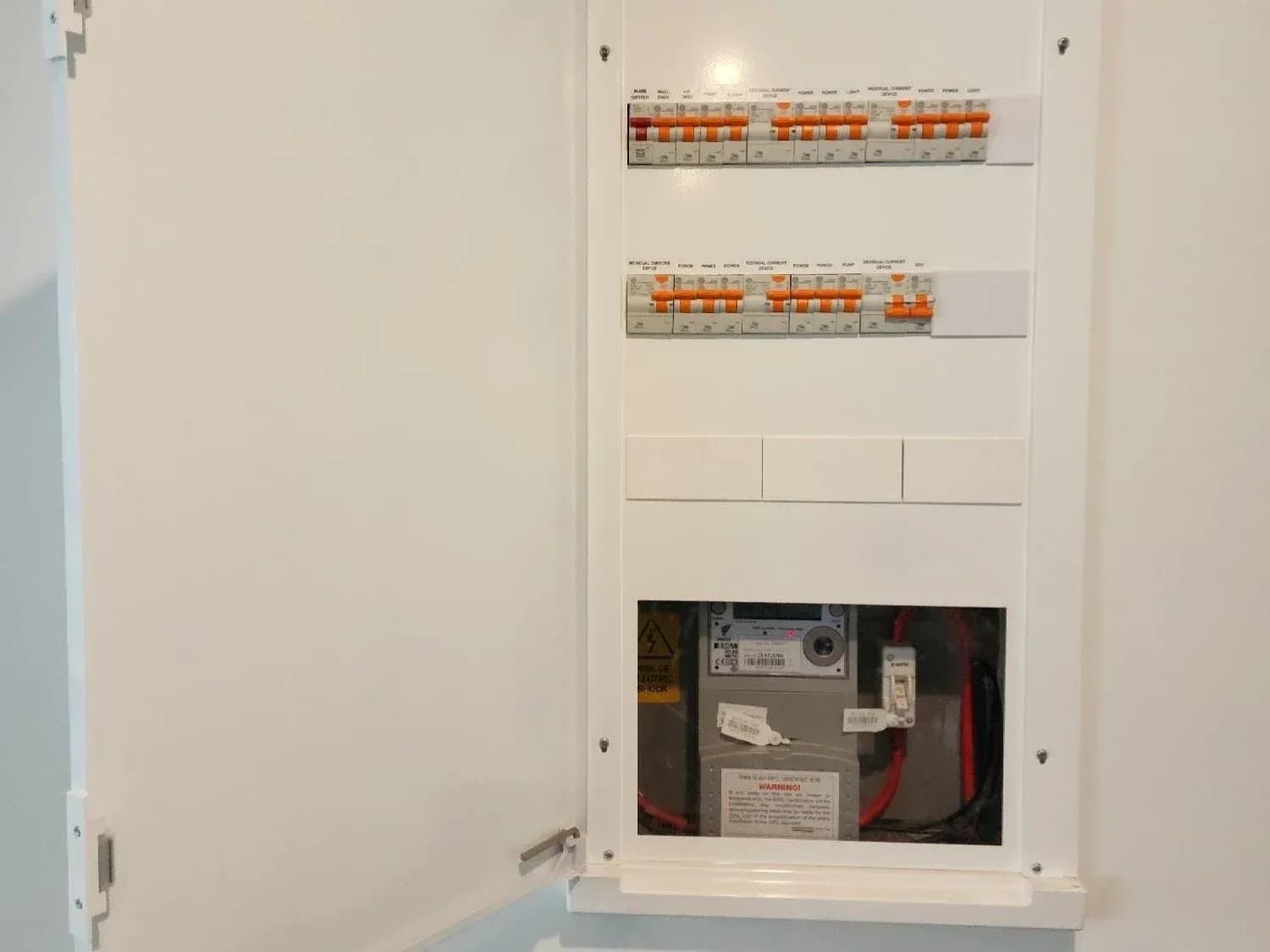
- A photo of your switchboard with the door open.
- Where you park, and roughly how far it is from the switchboard.
- The make and model of your EV (or the one you are planning to buy).
- Whether you have, or plan to add, an induction cooktop, a spa or a heat pump.
- Whether you are on an EV or time-of-use electricity plan.
What affects the cost
We do not publish a standard price because installations vary a lot. The main factors are the charger itself, the distance and route from the switchboard to the parking spot, whether the switchboard has space and capacity, and whether load management or a switchboard upgrade is needed. Our article on EV charger installation costs in NZ explains each of these.
FAQ
EV chargers: common questions
Do I need a switchboard upgrade for an EV charger?
Not always. It depends on whether the board has space and RCD protection suited to the charger, and on your total load, including cooking, hot water and heating. A smart charger with load management can sometimes avoid an upgrade.
Can I keep charging from a normal power point?
You can, but EECA says 3-pin charging is not recommended on a long-term basis and recommends charge points designed for EVs, installed by a qualified installer. A dedicated charger is faster and is on its own protected circuit.
What is a smart charger, and do I need one?
A smart charger can schedule charging for off-peak times and balance its load against the rest of the house. EECA notes you could get some of the off-peak benefit with a non-smart charger by charging manually at off-peak times, but a smart charger does it automatically.
Will I get a certificate?
Yes. An EV charger installation is certified with a Certificate of Compliance, and you receive an Electrical Safety Certificate once it is connected. EECA advises making sure you receive both.
Can you install a charger at a workplace or apartment building?
Yes. Commercial and multi-unit sites need more planning around load, metering and access, so we start with a site visit. See commercial electrical.
I am building a new home. Should I wire for an EV now?
It is worth it even if you do not have an EV yet. A cable to the garage and space on the switchboard costs much less during the build than retrofitting. See new build electrical.
Can I install the charger myself?
No. A new circuit to a charger is not homeowner work. It must be installed, tested and certified by a licensed electrical worker. See what electrical work you can do yourself.
What customers say
5.0 from 47 Google reviewsCustomer reviews
“Ryan was recommended by our friend to install a Tesla Wall Connector EV charger at my home in Northshore, Auckland. He knew exactly what the requirement was and gave us a very reasonable quote. Two weeks ago, his team came on time and installed it professionally. Last week we have a problem with one of the electric circuits. Ryan's team came to repair the fault and replaced two faulty MCBs promptly. Again very reasonable price. High recommended!”
“Super professional guys, did a number of jobs for us, from a single power point installation to rewiring entire room and installing new lights. Ryan is down to earth and straight to the point man, absolute pleasure to deal with. Heavily recommended.”
“We’ve been working with Ryan and his team at Plexus Electrical since 2016, and we can’t recommend him highly enough. Over the years, Ryan has consistently delivered exceptional service for our projects. He’s reliable, professional, and always brings a high level of expertise to every job. Whether it’s been smaller jobs or more complex work, he approaches everything with care and precision. It’s amazing having someone like Ryan as part of our trusted team. A true professional and a pleasure to work with!”
Get an EV charger quote
Tell us about your car, where you park and what else runs in the house. A switchboard photo helps.
More on ev chargers
Keep exploring
Services and tools