
Mains supply upgrades
When the supply to the house, not the switchboard, is the limit
Every home has a maximum it can draw from the network, set by its connection: the fuse rating and whether the supply is single phase or three phase. Most homes never come close. Add an EV charger, a ducted heat pump, an induction cooktop and a spa, and some will. Plexus works out your real load first, and only recommends a supply upgrade when it is the right answer. When it is, we do the electrical work on your side and help you through the application to Vector, which manages the network in most of Auckland.

When the supply to the house, not the switchboard, limits an EV charger, heat pumps, induction cooking or a spa, and what an upgrade involves.
Get your supply and switchboard assessedHow it fits together
Switchboard, mains and network: three different things
The network is the lines company's. In most of Auckland that is Vector, which owns its equipment up to the point of supply, usually the isolating fuse at the boundary of your property or on the nearest pole (Vector: line ownership).
The mains cable (the service line) runs from the point of supply to your meter board. Vector says the property owner typically owns the service line between the point of supply and the meter, although boundaries vary by property. Your meter is generally your electricity retailer's responsibility.
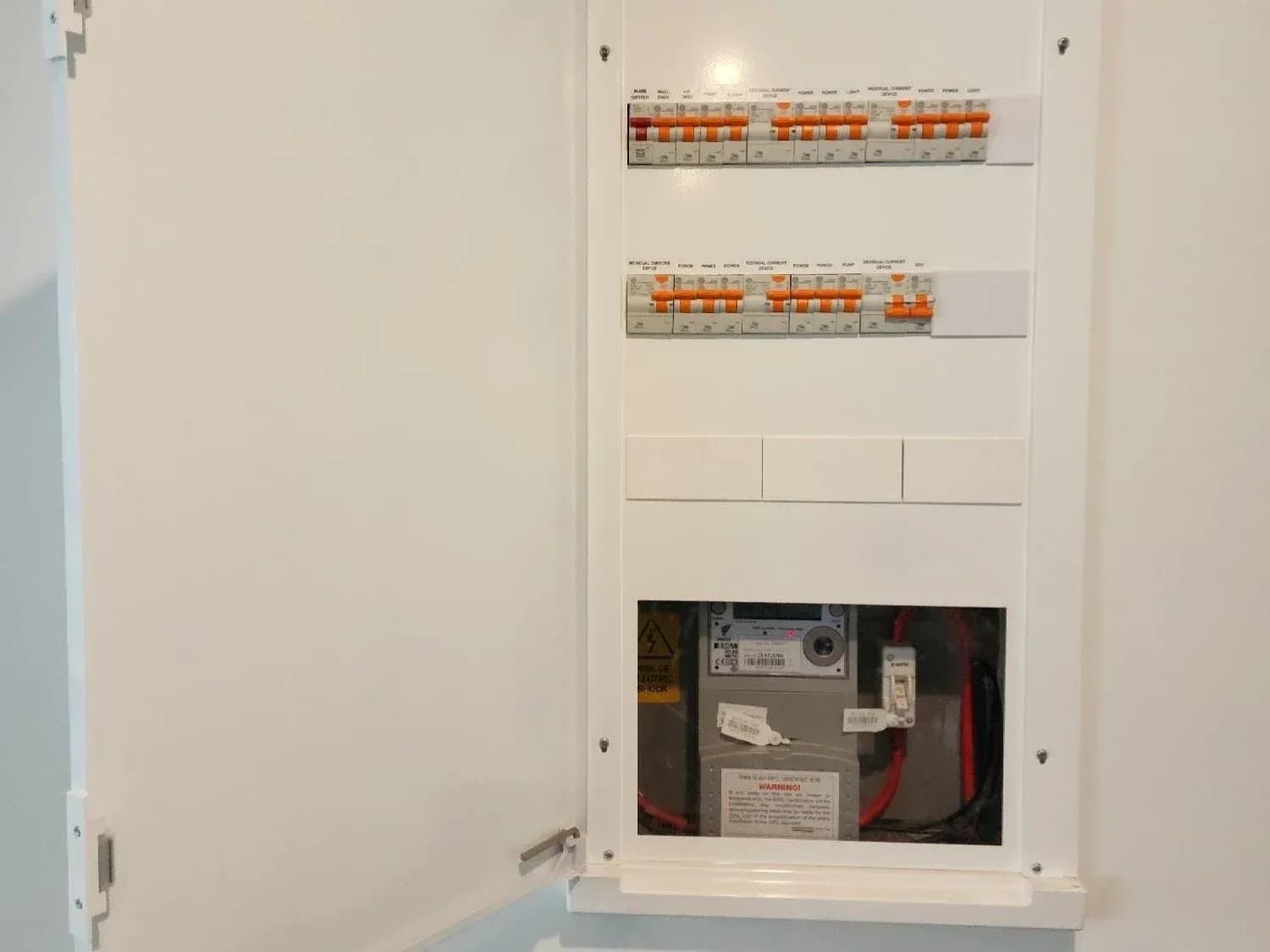
The switchboard is inside or on the house and divides the supply into protected circuits. A board can be out of space or lack RCD protection while the supply is fine, and the reverse. That is why we check both. See switchboard upgrades for the board itself.
The loads that can push a home's supply
None of these automatically means an upgrade. The question is what runs at the same time, and for how long.
| Adding | Why it matters for the supply | Related |
|---|---|---|
| EV charger | A steady, heavy load for hours, often overnight alongside heating and hot water. A single-phase wall charger is typically about 7 kW; 11 or 22 kW chargers need a three-phase supply and a car that can accept that rate. | EV charger installation |
| Heat pumps and ducted systems | A heat pump's electrical input is much lower than its heating output, but a ducted system or several heat pumps running on a cold evening add up, at the same time as everything else. | Ducted air conditioning |
| Induction cooktop or oven | A large load at the busiest time of day, on a dedicated circuit sized to the appliance. | Power points and appliances |
| Spa or pool | Heating and pumps that can run for long periods, on a dedicated, protected circuit. | Spa pool electrical |
Signs the supply may be the limit
Each of these is a reason to have the load assessed, not proof that you need an upgrade.
- You are planning two or more large loads, such as an EV charger and a ducted heat pump, at the same time.
- You want an 11 or 22 kW EV charger and the house is single phase.
- A smart EV charger is constantly reducing its charging rate because the house is busy.
- The supply fuse has blown when several large appliances were running together.
- Lights dim noticeably when a large appliance starts.
- The mains cable or overhead service line is old, damaged or has been added to over the years.
Single or three phase
Do you need three-phase power?
Most homes have a single-phase supply. A three-phase supply spreads the load across three phases and allows larger equipment, such as an 11 or 22 kW EV charger. It is worth it when the loads you plan genuinely need it, not as a default.
For EV charging in particular, the car's onboard charger often sets the real limit: there is no point in a 22 kW charger if the car accepts 7 kW on AC charging. Our home EV charging guide explains what limits charging speed, and the EV charging calculator shows how long a charge takes at 7, 11 and 22 kW.
What a supply upgrade involves
This is the general shape of the process. Vector sets out its own steps on its website, and they can change.
- STEP 01
Load assessment
We list what you have and what you plan to add, work out what is likely to run at the same time, and check the switchboard and mains cable. Often this shows an upgrade is not needed.
- STEP 02
Confirm the existing connection
Vector can verify the property's existing phase and fuse size through its capacity request service.
- STEP 03
Application to Vector
If an upgrade is needed, the request goes to Vector with the phase and fuse requirements from your electrician. Vector assesses whether its network has the capacity and quotes any network work.
- STEP 04
Network and meter
Vector carries out any work on its network. Your electricity retailer arranges any meter or fuse changes.
- STEP 05
Work on your side
We carry out the electrical work on your side of the point of supply: the mains cable where it needs upgrading, the meter board and the switchboard.
- STEP 06
Inspect, test and certify
Work on the mains is high-risk electrical work. It is inspected by an authorised inspector and recorded on a Record of Inspection, alongside the Certificate of Compliance and Electrical Safety Certificate.
Who does what
| Who | Their part |
|---|---|
| Vector (the lines company) | Owns the network up to the point of supply. Assesses capacity, quotes and carries out network work, and updates the connection record. Its fees and processes are published on its website. |
| Your electricity retailer | Generally responsible for the meter, and arranges meter or fuse changes. |
| Your electrician | Assesses the load, advises on the phase and fuse size you need, and does the electrical work on your side of the point of supply, including the mains cable and switchboard. |
| You, the property owner | Request the change from Vector, typically own the service line on your property, and accept and pay Vector's quote. |
The switchboard
The switchboard usually changes too
A bigger or three-phase supply needs a switchboard that can take it: a main switch rated for the new supply, room for the new circuits, and RCD protection to current rules. If the existing board is old, it often makes sense to replace it at the same time, with one shutdown. See switchboard upgrades for what that involves.
FAQ
Mains supply and three-phase upgrades: common questions
How do I know whether my house is single phase or three phase?
Your electrician can tell from the meter board and switchboard. Vector can also verify a property's existing phase and fuse size through its capacity request service.
Do I need three-phase power for an EV charger?
Only for an 11 or 22 kW charger, and only if your car can accept that rate. Most home chargers are single phase at about 7 kW, which suits most daily driving. See our home EV charging guide.
Do I need a supply upgrade for a heat pump?
Rarely for a single high-wall heat pump. A ducted system or several heat pumps, added to an EV charger and induction cooking, is when the supply is worth checking. We look at the whole load when we quote heat pump and electrical work together.
How much does a supply upgrade cost?
It depends on Vector's part (which it quotes separately and publishes fees for on its website), whether the mains cable on your property needs replacing, the distance from the point of supply to the meter board, and whether the switchboard changes too. We quote our part once we have assessed the load and the site.
Who owns the cable from the street to my house?
Vector says the property owner typically owns the service line between the point of supply and the meter, although boundaries vary by property. Vector's line ownership page explains how to check.
Can a smart EV charger avoid a supply upgrade?
Often, yes. A smart charger with load management reduces its charging rate when the rest of the house is using a lot of power, so the total stays within what the supply can carry. We check whether that is enough before recommending an upgrade.
How long does a supply upgrade take?
Vector sets the timeframes for its part and publishes them on its website. Our part is planned around Vector's work, and we will tell you how long the power is likely to be off before we start.
What customers say
5.0 from 47 Google reviewsCustomer reviews
“Super professional guys, did a number of jobs for us, from a single power point installation to rewiring entire room and installing new lights. Ryan is down to earth and straight to the point man, absolute pleasure to deal with. Heavily recommended.”
“We’ve been working with Ryan and his team at Plexus Electrical since 2016, and we can’t recommend him highly enough. Over the years, Ryan has consistently delivered exceptional service for our projects. He’s reliable, professional, and always brings a high level of expertise to every job. Whether it’s been smaller jobs or more complex work, he approaches everything with care and precision. It’s amazing having someone like Ryan as part of our trusted team. A true professional and a pleasure to work with!”
“Plexus Electrical are such a good company to work with. We have been using them to do full renovations for a number of years now and would highly recommend them. Ryan is really responsive and efficient and the guys are great. Excellent communication and good pricing. Awesome company to work with!”
Get your supply and switchboard assessed
Tell us what you have and what you plan to add (EV charger, heat pumps, induction cooking, a spa). Photos of the switchboard and meter board help.
More on mains supply and three-phase upgrades
Keep exploring
Services and tools